How NVIDIA, Apple and Qualcomm can design advanced processors without owning the factories that manufacture them.
A modern processor can fit in the palm of your hand. Yet the work behind it spans continents, hundreds of specialist suppliers and some of the most advanced factories ever built.
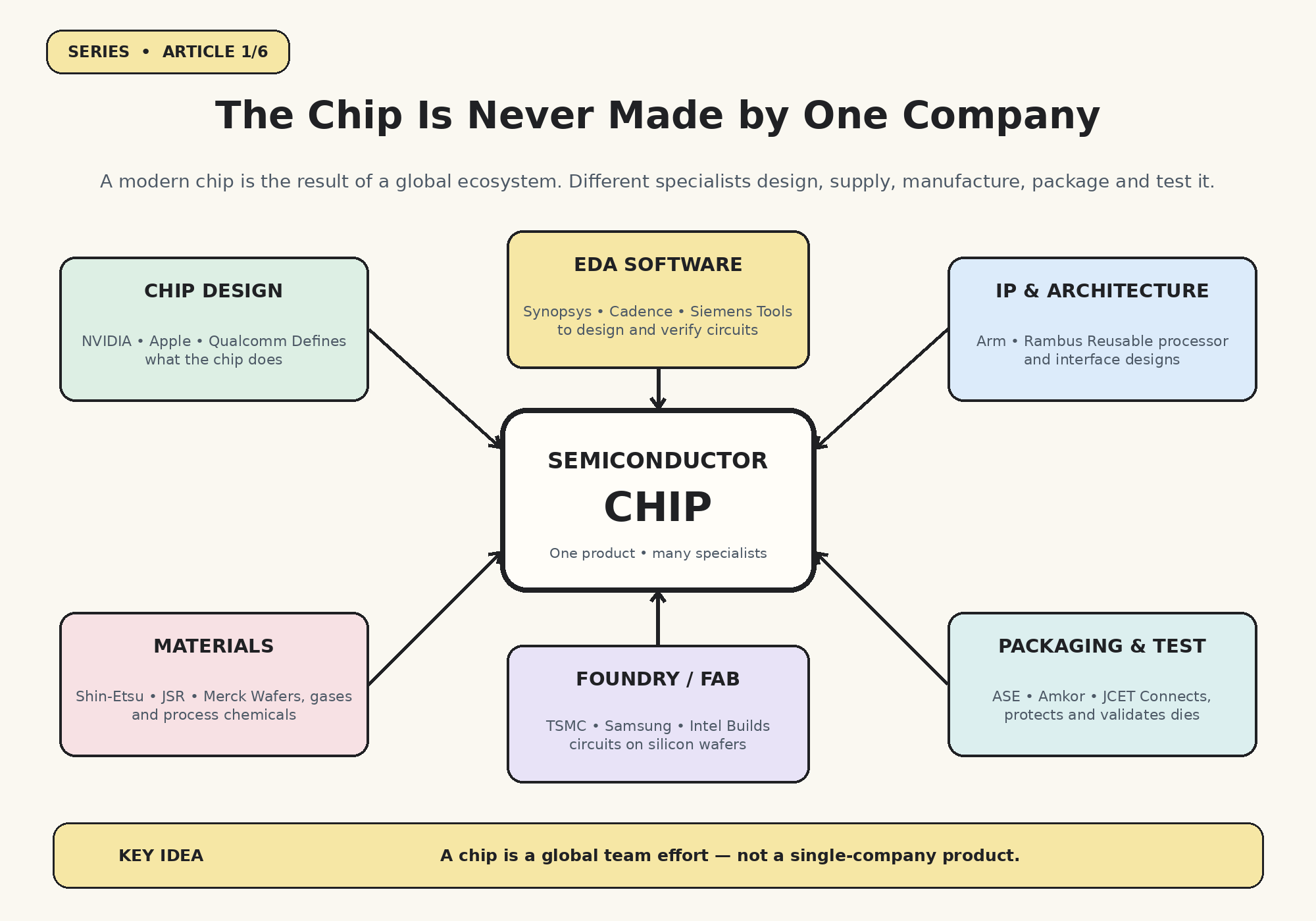
Take an AI processor. One company may design its architecture. Another supplies the software used to design its circuits. A specialist company builds the lithography machine. A foundry manufactures the silicon. Memory comes from a separate supplier. Another company may package and test the finished chip.
So who actually makes the chip?
The surprising answer: many companies make different parts of it possible.
1. Start with a simple distinction
When people say “chip company”, they often mean very different things.
- Chip designer: decides what the chip should do and designs its circuits.
- IP company: licenses reusable building blocks, such as processor architectures or interface designs.
- EDA company: makes the software engineers use to design and verify chips.
- Materials supplier: provides wafers, gases, chemicals and other specialised materials.
- Equipment maker: builds the machines used inside semiconductor factories.
- Foundry: manufactures chips on wafers for customers.
- IDM (integrated device manufacturer): designs and manufactures its own chips, as Intel, Texas Instruments and Micron do.
- OSAT company: performs outsourced assembly, packaging and testing.
- Test equipment maker: builds the machines that verify chips, such as Advantest and Teradyne.
- System company: puts chips into phones, cars, computers or servers.
These roles fit together, but they are not interchangeable.
2. Fabless: designing without owning the fab
NVIDIA, Qualcomm, AMD and MediaTek are well-known examples of fabless semiconductor companies for many of their products.
“Fabless” means they focus on chip design and product development while outsourcing wafer manufacturing to foundries.
Apple also designs its own processors, including Apple Silicon, while relying on external manufacturing partners.
Why do this? Because designing a chip and building a leading-edge fabrication plant require very different capabilities and investments. A company can focus on its strengths and buy manufacturing capacity from a specialist.
The opposite model also exists. An integrated device manufacturer, or IDM, both designs and manufactures its own chips. Intel, Texas Instruments and Micron work this way, and Samsung straddles both worlds: it builds its own processors and memory while also running a foundry for external customers.
3. The foundry: the factory behind the design
A foundry takes a customer’s manufacturing-ready design and uses its process technology to build the physical circuits on silicon wafers.
Important foundry companies include:
- TSMC — Taiwan.
- Samsung Foundry — South Korea.
- GlobalFoundries — United States and international operations.
- UMC — Taiwan.
- SMIC — China.
- Intel Foundry — Intel’s manufacturing-services business.
A foundry does not simply print a drawing onto silicon. It must translate the design into a complex sequence of manufacturing operations, control variation, inspect defects and produce reliable dies at scale.
4. The hidden specialists
A foundry cannot operate alone.
It depends on companies such as:
| Specialist | Example companies | What they contribute |
|---|---|---|
| Chip design | NVIDIA, AMD, Qualcomm, Apple | Product and circuit design |
| Processor IP | Arm | Architecture and reusable CPU designs |
| EDA software | Synopsys, Cadence, Siemens EDA | Design, verification and physical-design tools |
| Lithography | ASML, Nikon, Canon | Patterning systems |
| Process equipment | Applied Materials, Lam Research, Tokyo Electron | Deposition, etch, cleaning and related tools |
| Inspection | KLA | Defect inspection and process control |
| Silicon wafers | Shin-Etsu, SUMCO, GlobalWafers, Siltronic | Polished semiconductor substrates |
| Packaging and test | ASE, Amkor, JCET | Assembly, packaging and testing |
| Memory | SK hynix, Samsung, Micron | DRAM, NAND and high-bandwidth memory |
This is a representative map, not a complete approved-vendor list. Supplier relationships differ by product, technology and generation.
5. One product, many supply chains
NVIDIA’s public filings describe a supply chain that uses foundries including TSMC and Samsung for wafer production, memory suppliers including SK hynix, Micron and Samsung, and CoWoS packaging technology. Final system assembly also involves independent subcontractors and contract manufacturers.
That is a useful real-world example of the industry’s structure: the company that owns the product design does not necessarily own the factories or every manufacturing step. NVIDIA annual filing.
The same pattern repeats across well-known products:
| Chip | Designed by | Manufactured by | Assembled and tested by |
|---|---|---|---|
| Apple A- and M-series | Apple | TSMC | ASE, Amkor |
| NVIDIA GPUs | NVIDIA | TSMC, Samsung | ASE |
| Qualcomm Snapdragon | Qualcomm | TSMC, Samsung | Amkor, JCET |
| Tesla Dojo | Tesla | TSMC | TSMC and its partners |
A single advanced product can easily involve 50 to 100 or more companies across materials, tools, design, manufacturing and assembly.
A single advanced AI accelerator can bring together:
- A compute die.
- High-bandwidth memory stacks.
- An advanced package or interposer.
- A substrate and external connections.
- Cooling and power components.
- A board, server and networking system.
The final product is the outcome of a coordinated industrial network.
6. Why the industry is divided this way
Semiconductor manufacturing is difficult for three reasons:
Extreme specialisation. Lithography optics, wafer chemistry, chip architecture and packaging require different scientific and engineering expertise.
Huge capital requirements. A leading-edge fab costs many billions of dollars and needs a continuous pipeline of qualified tools, materials and skilled people.
Scale and learning. A specialist supplier serving many customers can develop deep expertise and spread its investment across a much larger market.
The result is an industry where collaboration is not optional. It is the operating model.
The takeaway
A processor is not a product that comes from one factory. It is a product of a global ecosystem.
NVIDIA may design the GPU. Arm may provide architecture or IP. Synopsys and Cadence help engineers design it. ASML and other equipment makers supply critical machines. TSMC or another foundry fabricates the wafer. Memory companies provide HBM. Packaging specialists turn the dies into a usable component.
The chip has one brand on the box, but a world of engineering behind it.
Next in the series: Before a chip can be manufactured, where do its silicon, metals, gases and extraordinary chemicals come from?